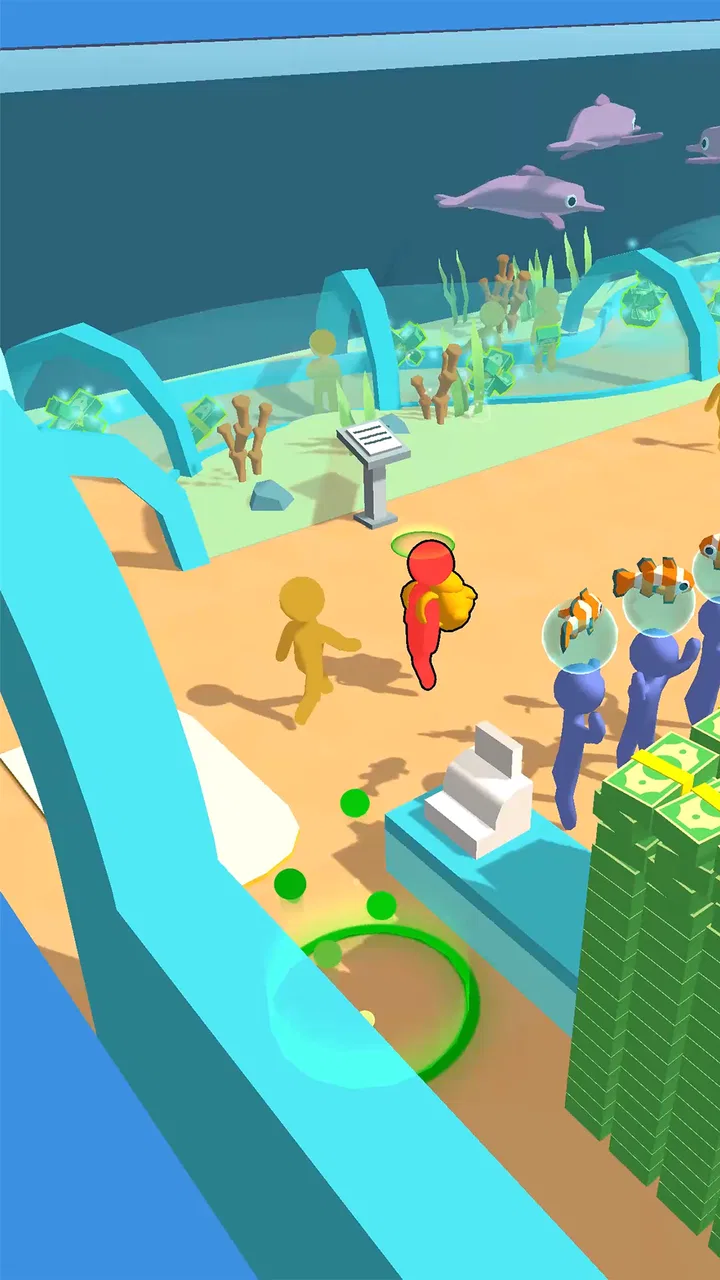
Aquarium Land — Fishbowl World
- 4.3
- Rating
- 50.00M
- Installs
- Free
- Price

 Analysis by App-foxy
I usually approach aquarium games expecting a pleasant distraction rather than a deep arcade challenge, and Aquarium Land — Fishbowl World fits that expectation well. It is a free game from Homa in the arcade category, built around catching fish, improving an aquarium, and collecting rewards at a relaxed pace. The first sessions are easy to understand: move through the fishing activity, bring new creatures back to the tank, and use the results to make the aquarium feel more complete.
What interested me more was not the opening loop, but whether it had enough recurring value to remain installed after the novelty disappeared. Plenty of casual games are enjoyable for a few days and then become background clutter. This one has a stronger chance of surviving that test if you like short, low-pressure play sessions, although it is not the right choice for someone looking for complex strategy, demanding reflexes, or a highly detailed aquarium simulator.
From an appealing first week to a more routine habit
The opening experience is deliberately approachable. I never felt that I needed to study instructions before starting, and the aquarium gives the game a clear sense of progress beyond simply finishing one arcade round. Each successful fishing session has a visible purpose: the collection grows, the tank becomes more interesting, and rewards give me a reason to return.
You May Also Like

 Blood Strike: 2.5 Anniversary
Blood Strike’s Loadouts Turn Every Drop Into a Tactical Gamble
A close look at Blood Strike’s custom loadouts: how fast access to signature weapons reshapes its battle royale rhythm, rewards preparation, and narrows the gap between fights.

 Pandora - Music & Podcasts
Pandora’s Music Is Easy to Start, but Harder to Recover
Pandora’s strength is its low-effort path from a seed to a station. Its weak spot is how much confidence it asks you to place in connection, setup, and quiet recovery.

 8 Ball Pool
 Is Built on Rivalries, Rematches, and Routine
A close look at the rivalries, rematches, shared routines, and unanswered safety questions that turn a quick pool match into a persistent mobile community.

 Samsung Music
’s Quiet Strength Is Playing What You Already Own
Its reach comes less from spectacle than from dependable access to a personal library. That simplicity is both the app’s strongest retention engine and its ceiling.

 AccuWeather: Weather Radar
AccuWeather Review: A Quick, Clear Forecast for Everyday Decisions
For everyday plans, the best forecast is the one you can understand quickly. AccuWeather makes rain timing, radar, and local conditions easy to act on, with a few trade-offs.

 Hill Climb Racing
Why Hill Climb Racing Still Turns Crashes Into One More Run
A tiny car, a bumpy hill and one more upgrade: Hill Climb Racing keeps resurfacing because its simple chaos makes every near-miss feel personal.
More From Our News Desk



That simplicity is the main first-week strength. I can play for a few minutes while waiting for an appointment, take a break between tasks, or use it as a gentle wind-down game before bed. It does not demand the concentration of a competitive action title, and it avoids the heavy planning associated with management games. The aquarium theme also makes the progress feel more personal than a sequence of disconnected levels.
At the same time, the early charm comes partly from discovery. New fish and aquarium progress create small moments of anticipation, but that effect naturally becomes less powerful once the collection starts to feel familiar. I found the game most enjoyable when I treated each session as a compact activity rather than expecting a major new event every time I opened it.
The controls and objectives are suited to players who want immediate feedback. Younger players can understand the basic idea, and the Everyone age rating reflects that accessible presentation. Parents should still remember that the game includes optional in-app purchases, so the device’s purchase settings are worth checking before handing it to a child.
One useful habit is to decide before opening the game what kind of session I want. If I have only a few minutes, I focus on the fishing activity and leave the aquarium adjustments for later. If I have more time, I use the collection as a reason to review what I have earned and decide what progress feels most satisfying. Separating those two moods prevents the game from feeling like an endless obligation.
What makes the aquarium more than decoration
The tank is not just a background image behind the arcade action. It gives the rewards a destination, which helps the basic fishing loop avoid feeling completely disposable. In many quick arcade games, finishing a round produces a number that has little emotional meaning. Here, the result connects to a growing visual space, so I have a clearer reason to care about the next catch.
That connection is especially useful for players who enjoy collecting without wanting a complicated spreadsheet of objectives. I can play casually and still feel that the aquarium is changing over time. The trade-off is that the collection motivation depends heavily on how much I enjoy the theme. If colorful fish and gradual aquarium improvement do not appeal to you, the central reward loop may lose its pull quickly.
I also recommend resisting the urge to judge the entire game by its first few sessions. The beginning is designed to make progress feel frequent, while longer-term play is more about whether the routine itself remains pleasant. The right question is not whether every session feels exciting, but whether a short return still feels worthwhile after the initial discoveries are gone.
How the game holds up from month to month
Long-term value in Aquarium Land depends on repetition. The central activities remain familiar, so the game works best as a small daily or occasional ritual rather than a title I would play continuously for long stretches. I can see myself opening it during idle moments, completing a manageable amount of fishing, and leaving before the loop starts to feel mechanical.
This is an important distinction from deeper arcade games. A traditional score-chasing game may keep me engaged through increasingly difficult timing, personal records, or intense competition. Aquarium Land leans more toward collection and relaxation. It gives me a reason to continue, but not necessarily a reason to master difficult techniques. Players who want constant skill growth may find the progression too gentle.
Compared with aquarium simulators, it is also lighter and more immediately playable. A simulation usually asks me to think about care, resources, balance, or detailed customization. This game offers the atmosphere of an aquarium without turning the experience into a demanding responsibility. That makes it easier to pick up, but it also means it cannot replace a serious virtual fishkeeping experience for someone who wants depth.
For month-to-month use, I would set a realistic expectation: this is a comfort game, not a main game. It earns recurring attention when I want something visually pleasant and uncomplicated. It struggles when I expect a constant stream of new mechanics or a substantial reason to return every day. The difference between those expectations largely determines whether it stays installed.
A practical approach is to use it alongside, not instead of, a more demanding game. I might play a competitive title when I want challenge and switch to this one when I want a calmer break. That division of purpose helps preserve its appeal because I am not asking one small arcade game to satisfy every gaming mood.
Rewards, purchases, and the value of playing casually
The game is free to download and includes optional purchases ranging from under a dollar to amounts close to one hundred dollars per item. That wide range matters when considering long-term value. I would treat purchases as convenience spending rather than part of the basic reason to install the game. The free loop should be the test: if catching fish and developing the aquarium are not enjoyable without spending, buying more will not solve the underlying problem.
I prefer to let the aquarium progress at its natural pace. That makes each addition feel earned and protects the game from becoming a shopping exercise. Players who are comfortable waiting and returning in short sessions are likely to get more satisfaction than players who want to accelerate every reward immediately.
There is also a psychological trade-off in reward-driven games. Frequent progress can make a short session feel productive, but it can also encourage opening the app out of habit rather than genuine interest. I found it helpful to stop after completing the activity I intended to do instead of continuing automatically. That small boundary keeps a relaxing game from turning into a repetitive chore.
The game has reached a broad audience, with more than fifty million installs and an average rating of 4.3 from roughly one hundred twelve thousand ratings. Those figures suggest that the accessible fishing-and-aquarium formula has connected with many players, but popularity does not remove the main question: whether its gentle repetition matches my own taste after the first week.
Maintenance: what returning actually asks of me
The maintenance burden is relatively low in the sense that the game does not require me to manage a real aquarium or remember complicated systems. I can leave it alone and return when I feel like playing. That is a major advantage over games built around constant upkeep, where missing a day can feel like falling behind.
However, low maintenance does not mean unlimited freshness. The player’s responsibility is mostly motivational: I have to decide whether the next short session still feels rewarding. The aquarium provides continuity, but it cannot completely hide the fact that the core actions repeat. For me, the best routine is occasional play with a clear stopping point, not forcing a daily commitment.
Device compatibility is broad enough for older supported phones, since the minimum requirement is Android 7.0. The current version is 2.13.0, which is useful context for anyone checking whether their device can run it. I would still keep expectations sensible on older hardware: a game can be compatible while feeling less comfortable on a small or slower device than on a newer one.
The game’s simple concept also makes it suitable for shared family situations. A child can understand the aquarium goal quickly, while an adult can use it as a quiet casual game. The purchase range means supervision remains sensible, but the basic design is much easier to explain than a dense strategy title.
One maintenance tip is to avoid turning collection completion into a personal obligation. The aquarium is most enjoyable when it feels like a pleasant record of play. If I start treating every missing fish or reward as something I must obtain immediately, the calm tone changes into pressure. The game works better as a flexible pastime than as a checklist demanding constant attention.
Where the routine starts to lose energy
The clearest source of fatigue is repetition. Fishing, receiving rewards, and improving the aquarium form a clean loop, but a clean loop can become predictable. After the first discoveries, I may know exactly what kind of session I am about to have. That predictability is comforting for some players and limiting for others.
Another possible frustration is the gap between a relaxing game and a reward-focused game. The aquarium theme suggests calm, while progression systems naturally encourage me to keep playing. When those motivations align, the game feels satisfying. When they do not, I may feel that I am repeating an action mainly to reach the next reward rather than because the activity itself remains engaging.
Purchases can add to that fatigue if I feel pushed to speed up progress. Even without spending, simply seeing expensive optional items can change how I evaluate the pace of the free experience. My advice is to decide in advance whether you are willing to spend anything. If the answer is no, play it as a slow collection game and do not measure your progress against a faster route.
The game is also not ideal for players who want a strong narrative, complex aquarium care, or competitive leaderboards as their main motivation. A dedicated simulation is better for detailed fishkeeping decisions. A skill-based arcade game is better for players who want precision and rising difficulty. Aquarium Land occupies the middle ground: more purposeful than a bare mini-game, but much lighter than either specialist alternative.
I would also skip it if I know that I lose interest whenever a game repeats one central action. The aquarium can soften repetition, but it cannot eliminate it. The title is specific about its appeal: it is for people who enjoy a soothing collection loop, not for anyone searching for a constantly changing adventure.
My long-term verdict after the novelty fades
After the initial charm wears down, Aquarium Land remains worthwhile as a small, low-pressure arcade game rather than a permanent centerpiece of my gaming time. Its strongest quality is the clear relationship between the fishing activity and the aquarium. I always understand why I am completing the next session, and the result feels more tangible than a score that disappears when the round ends.
Its weakness is equally clear: the recurring value depends on enjoying repetition. The game does not need to be difficult to be good, but it does need the player to appreciate gradual collection and short returns. If that sounds like your kind of play, the free entry point makes it easy to test without committing money first.
Homa has built something approachable for casual players, families, and anyone who wants a gentle break instead of an intense arcade challenge. The Everyone rating, broad device support, and large player base make it an easy recommendation for that audience, while the optional purchases are a reason to keep spending under deliberate control.
My personal recommendation is to install it when you want a relaxing aquarium-themed routine, then give it a week to see whether the collection loop feels naturally rewarding. Do not judge it by how much time it can occupy in one sitting. Judge it by whether you are happy to return for a short session after the first excitement has passed.
The lasting value is in the calm routine, not endless novelty. For me, that is enough to keep Aquarium Land available as an occasional comfort game, but not enough to make it a must-have for players who demand deep systems or constant challenge. If you want a friendly way to catch fish, build a visual collection, and fill spare minutes without managing a complicated virtual world, it earns a place. If you need every month to bring a fundamentally new experience, another arcade game or a fuller aquarium simulator will serve you better.
FAQs for Aquarium Land — Fishbowl World
01What is Aquarium Land — Fishbowl World?
Aquarium Land — Fishbowl World is a captivating simulation game where players create and manage their own virtual aquarium. Users can collect a variety of fish, decorate their tanks, and participate in engaging challenges. It's designed for both casual gamers and aquarium enthusiasts, offering hours of relaxing entertainment.
02Is Aquarium Land — Fishbowl World free to play?
Yes, Aquarium Land — Fishbowl World is free to download and play on both Android and iOS devices. However, the game may offer in-app purchases for additional items, decorations, or faster progression. Players can enjoy the game without spending money, but purchases can enhance the experience.
03What are the main features of Aquarium Land — Fishbowl World?
The game features a wide variety of fish species to collect, customizable tanks, and interactive gameplay elements. Players can complete missions, breed fish, and unlock new decorations. The game also includes social features, allowing users to visit friends' aquariums and share their own creations.
04Does Aquarium Land — Fishbowl World require an internet connection?
An internet connection is recommended for Aquarium Land — Fishbowl World to access all features, such as social interactions and updates. While some aspects of the game can be played offline, an online connection enhances gameplay by enabling cloud saves and the ability to participate in online events.
05Are there any age restrictions for playing Aquarium Land — Fishbowl World?
Aquarium Land — Fishbowl World is suitable for players of all ages, making it an excellent choice for families and younger audiences. However, parents should be aware of in-app purchases and supervise spending. The game’s user-friendly interface and educational aspects make it accessible and enjoyable for kids.
Pros
- Engaging and intuitive gameplay.
- Stunning aquatic graphics.
- Regular updates with new features.
- Easy controls and navigation.
- Relaxing and immersive experience.
Cons
- In-app purchases can be pricey.
- Requires a stable internet connection.
- Ads may interrupt gameplay.
- Limited offline features.
- Occasional performance lags.

Aquarium Land — Fishbowl World
Gallery